Lake Torneträsk Shoreline
Winter night hours
The expansive frozen lake surface provides an unobstructed northern horizon for observing aurora activity. Access via the marked trails from the visitor center.

Aurora predictions arrive as a tidy number, and that number explains less than most visitors assume. This abisko northern lights forecast guide separates the geomagnetic signal from the local sky conditions that actually decide whether anything is visible. Read it before you plan the shape of your trip around a single app screen.
Quick answer
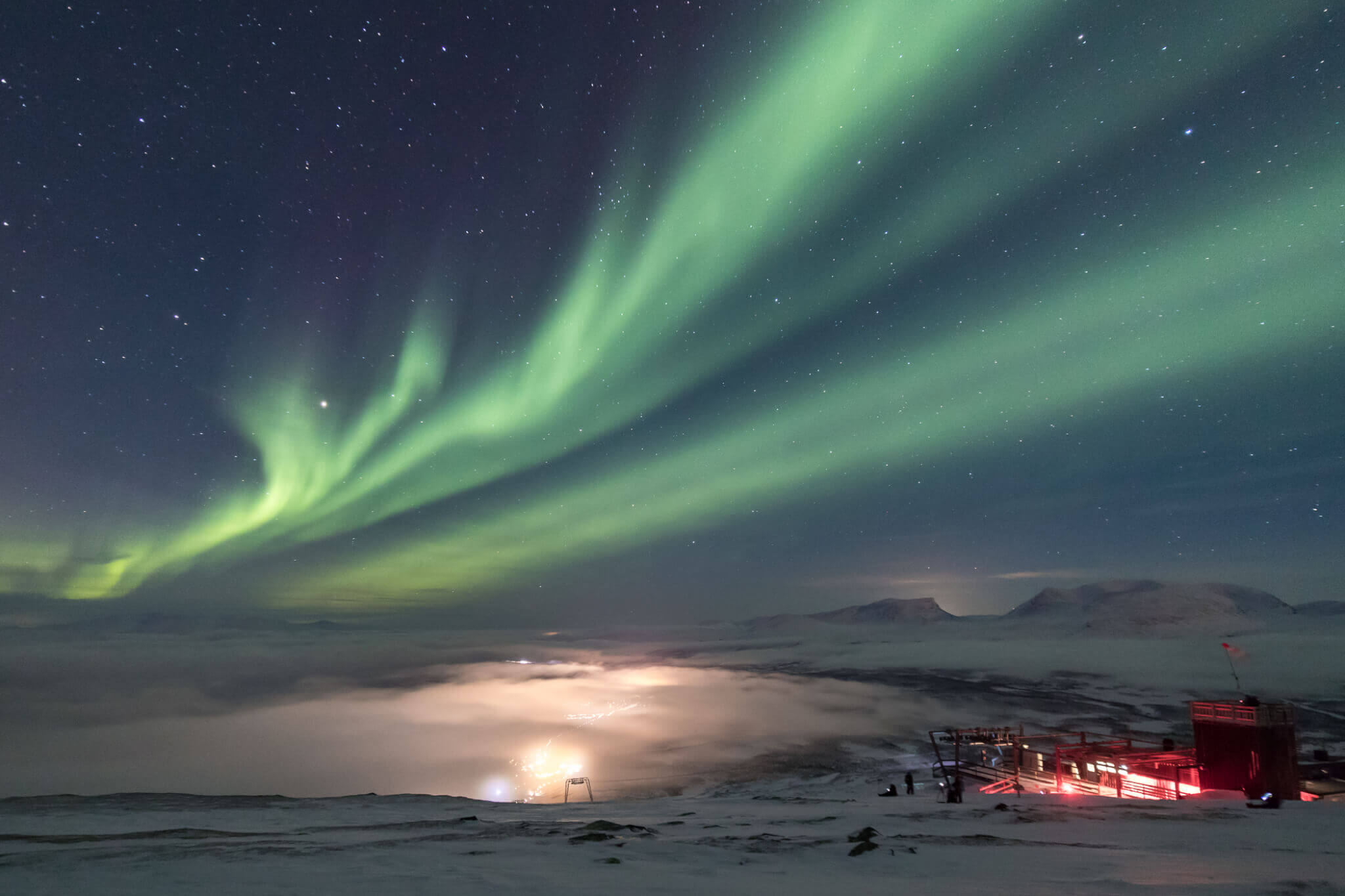
Abisko National Park is open 00:00–23:59 daily with free entry at 0 SEK, so the forecast, not the gate, governs your night. Aurora predictions combine a geomagnetic index with local cloud cover; the geomagnetic figure only matters once the sky is clear. The caveat: even a modest index produces visible activity here when conditions cooperate.
The Abisko Scientific Research Station has been recording conditions in this valley since 1913, which means the area's reputation for clear skies rests on more than a century of measurement rather than marketing. That record matters, because it explains why a location 195 kilometres inside the Arctic Circle became a reference point for aurora observation at all. The abisko northern lights forecast a visitor reads on a phone is really two separate predictions stacked together, and confusing them is the most common planning mistake. The first prediction is geomagnetic. It describes solar wind reaching Earth and is expressed as a planetary index, updated in three-hour blocks and modelled from satellite data at the L1 point roughly an hour upstream. It is a global figure. It knows nothing about the Torneträsk basin, the Scandinavian mountains to the west, or the sky directly above Lapporten. The second prediction is meteorological: cloud cover, humidity, and the movement of weather systems inland from the Norwegian coast. This is the one that decides the night. A high geomagnetic reading under solid overcast produces nothing at all, while a quiet index under a clean sky still yields a visible green arc across the northern horizon, because Abisko sits beneath the auroral oval rather than at its edge. Used properly, an aurora prediction for Abisko is a scheduling tool, not a verdict. Treat the geomagnetic number as a rough measure of how bright and how far south any display might reach. Treat the cloud forecast as the actual go or no-go, and check it late, since Arctic weather models revise heavily within a twelve-hour window. Nordsken, the Swedish word for the phenomenon, appears frequently in local reporting and on regional sites worth cross-referencing. The practical consequence is a matter of trip length. Because no single night can be guaranteed, visitors who allow three or four consecutive nights in the area convert forecast uncertainty into reasonable odds, and guided outings can shift location when the valley clouds over. Read the abisko northern lights forecast daily rather than once, and let the numbers shape which night you commit to.
“A high geomagnetic reading under solid overcast produces nothing at all.”
Abisko National Park possesses unique geographic features that influence local weather patterns and aurora visibility. These meteorological conditions contribute to the region's reputation as a reliable location for northern lights observation.
Surrounding mountains create a rain shadow effect, often resulting in a patch of clear sky above Torneträsk lake even when surrounding areas experience cloud cover.
The park sits within the auroral oval, a ring-shaped zone around the geomagnetic north pole where northern lights activity is most frequent.
Mount Nuolja serves as a high-altitude vantage point accessible to visitors, providing an elevated position above lower-level cloud layers.
Abisko is one of the driest places in Sweden due to the mountain barrier that blocks moisture-heavy winds from the Atlantic Ocean.
The localized weather system reduces cloud development, significantly increasing the statistical probability of clear nights for aurora hunters.
The park's location at 68 degrees north places it precisely beneath the region of highest activity for the solar particles that cause the aurora borealis.
Winter night hours
The expansive frozen lake surface provides an unobstructed northern horizon for observing aurora activity. Access via the marked trails from the visitor center.
Winter night hours
This high-altitude platform offers panoramic views above the tree line, often located above the cloud layer. Access requires a chairlift ride.
Winter night hours
The forested path near the entrance allows for framing the aurora through birch trees. Follow the main park signage.
Winter night hours
This smaller lake provides calm water for capturing aurora reflections when conditions allow. Accessed by hiking trails from the main park area.
Aurora watching in Abisko means standing still outdoors in sub-zero temperatures, so preparation centres on staying warm and keeping your equipment working.
Abisko National Park remains accessible at all times, allowing visitors to follow the northern lights forecast regardless of the hour. The park is open for aurora observation continuously throughout the week.
Access to Abisko National Park for viewing the northern lights is entirely free for all visitors. There are no entrance fees or tickets required to enter the park grounds.
Verdict: A typical adult pays 0 SEK to enter the national park, though costs for private tours or equipment rentals may apply independently.
Everything you need to know about abisko northern lights forecast
The abisko northern lights forecast is highly regarded due to the unique microclimate of the region. While no prediction can guarantee sightings, local data provides the most accurate probability estimates for the area.
Optimal darkness for aurora viewing occurs during late night hours in winter months, making this the best arrival window to check the abisko northern lights forecast. You should prioritize monitoring cloud cover levels alongside geomagnetic activity.
Entry to the national park is free, as the entrance fee is 0 SEK. This allows visitors to access the park grounds at any time for viewing the night sky.
While the abisko northern lights forecast helps track solar activity, actual sightings depend on clear skies and local weather conditions. Visitors often check multiple meteorological sources to increase their chances of a successful observation.
Children are welcome to accompany guardians in the national park, provided they are dressed in appropriate arctic clothing. Safety and warmth are the primary concerns when waiting for the aurora to appear in the subarctic environment.
The blue hole is a unique weather phenomenon where the mountains shelter the area, often resulting in clear skies despite surrounding cloud cover. This geographical feature significantly improves the visibility of the night sky for those watching the lights.
Effective preparation involves dressing in layers and bringing a headlamp for safety while navigating the park trails. Checking the latest local weather updates ensures you are informed about potential visibility changes throughout the night.
Abisko National Park Tours
Read more Tickets & toursNorthern Lights Tours with Dinner
Read more GuideAbisko Northern Lights Webcam
Read more GuideWhen to See Northern Lights in Abisko
Read more GuideAbisko Northern Lights Tracker
Read more Tickets & toursKiruna to Abisko Northern Lights Tours
Read more Tickets & toursAbisko Northern Lights Packages
Read more